Planning a corporate MICE event involves much more than choosing a destination and booking a hotel. Whether it is a leadership conference, employee offsite, incentive trip or corporate retreat, the experience needs to be planned around people, objectives, budget and logistics.
For HR and admin teams, the challenge is often managing all these moving parts while ensuring employees have a smooth and memorable experience. A structured planning process can make the difference between an event that simply happens and one that actually delivers value.
Here is a practical approach to planning a successful corporate MICE event.
1. Start With the Purpose of the Event
Before discussing destinations, venues or activities, clearly define why the company is organising the event.
Is the objective to:
- Reward employees for strong performance?
- Improve team collaboration?
- Conduct a leadership meeting?
- Launch a product or business initiative?
- Build stronger relationships with clients or partners?
- Give employees a chance to relax and reconnect?
The objective should influence almost every later decision. A leadership conference may need a very different format from an employee incentive trip or a team-building offsite.
Starting with the purpose also makes it easier to measure whether the event achieved what it was supposed to.
2. Know Your Attendees
The same event format will not work for every group.
Consider the number of participants, age groups, seniority levels, travel preferences and accessibility requirements. You should also understand whether employees are travelling from one city or multiple locations.
For companies organising events in Bangalore, for example, the planning process may involve employees travelling from different offices across India. Travel schedules, airport transfers and accommodation therefore need to be considered early rather than treated as last-minute arrangements.
Understanding your attendees helps you create an experience that is comfortable, practical and relevant.
3. Set a Realistic MICE Budget
A common mistake is creating a budget based only on the hotel or travel cost.
A complete MICE budget should consider:
- Flights or transportation
- Hotel accommodation
- Meals and refreshments
- Meeting and conference arrangements
- Local transfers
- Team-building activities
- Entertainment
- Event production and AV
- Branding and collateral
- Gifts or recognition elements
- Contingency expenses
Keeping a contingency amount is particularly important because travel and event costs can change.
A clear budget also helps the planning team decide where to spend more and where to keep things simple.
4. Choose the Destination and Venue Carefully
The destination should support the purpose of the event rather than simply being attractive.
For a conference, the venue may need excellent meeting facilities, reliable connectivity and comfortable accommodation. For an incentive trip, the destination may need interesting experiences, sightseeing and leisure options.
Accessibility is another important consideration. If participants are travelling from different cities, the ease of reaching the destination can have a significant impact on the overall experience.
For Bangalore-based companies, destinations that offer convenient travel, good corporate facilities and a variety of activities can make planning more manageable.
5. Build an Itinerary That Is Practical
A packed itinerary may look impressive on paper, but it can quickly become tiring for participants.
Give people enough time to travel, check in, relax and enjoy the destination. Balance formal sessions with informal interaction and leisure.
For example, a corporate offsite could include:
Morning: Business sessions or workshops
Afternoon: Team activity or local experience
Evening: Networking dinner or entertainment
The exact schedule will depend on the event objective, but flexibility should always be considered.
A good itinerary gives participants structure without making them feel like they are following a strict timetable throughout the trip.
6. Plan the Logistics in Detail
Logistics often determine whether an event feels organised or stressful.
Create a detailed plan covering:
- Flight and travel schedules
- Airport or railway transfers
- Hotel check-in and check-out
- Room allocations
- Transportation between venues
- Meals and dietary requirements
- Event registration
- Meeting room setup
- AV and technical requirements
- Emergency contacts
- On-ground coordination
It is also useful to create a single master itinerary that can be shared with participants and internal stakeholders.
Everyone involved should know where they need to be, when they need to be there and who is responsible for each part of the program.
7. Prepare for Unexpected Situations
Even carefully planned corporate events can face unexpected challenges.
Flights may be delayed, weather conditions can change, vendors may face last-minute issues and participants may have individual requirements.
A good planning process should therefore include backup arrangements.
Think about alternative transportation, emergency contacts, backup vendors, indoor options for outdoor activities and additional time between important program elements.
The goal is not to predict every possible problem. It is to ensure that the team knows how to respond if something does happen.
8. Make the Experience Meaningful
The strongest MICE programs are usually built around a clear experience rather than a collection of activities.
For an employee incentive program, this could mean creating memorable destination experiences. For a team offsite, activities could be designed around communication and collaboration. For a leadership event, the focus may be on productive discussions and meaningful networking.
Even small details can make an event feel more personalised, such as welcome kits, thoughtful room arrangements, customised branding or recognition moments.
The experience should ultimately connect back to the reason the company organised the event.
9. Measure the Outcome
The event does not end when everyone returns home.
After the program, gather feedback from participants and internal stakeholders. Ask what worked well, what could have been improved and whether the event achieved its original objective.
Depending on the type of MICE event, you can measure:
- Participant satisfaction
- Attendance and participation
- Employee engagement
- Feedback on activities
- Business or networking outcomes
- Achievement of event objectives
- Overall budget performance
These insights can make future corporate events more efficient and relevant.
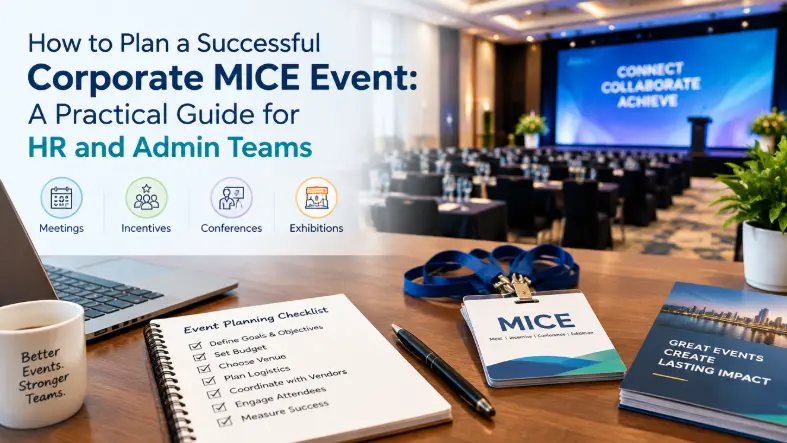
Corporate MICE Event Planning Checklist
Before the event, HR and admin teams should confirm:
- Event objective is clearly defined
- Participant list is finalised
- Budget is approved
- Destination and venue are confirmed
- Travel arrangements are complete
- Accommodation is booked
- Itinerary is finalised
- Activities are aligned with the objective
- Transportation is organised
- Food and dietary requirements are covered
- AV and production requirements are confirmed
- Emergency and backup plans are ready
- Participant communication has been completed
- Post-event feedback process is planned
Bringing the MICE Program Together
A successful corporate MICE event depends on how well the different elements work together. Travel, accommodation, activities, meetings, entertainment and on-ground coordination should feel like parts of one carefully planned experience.
For HR and admin teams, working with an experienced event partner can also simplify coordination across multiple vendors and locations. This becomes especially useful when the program involves complex travel arrangements, large groups or several activities.
Whether you are organising a corporate offsite, incentive trip, conference or employee experience, starting with a clear objective and building the event around your participants will give you a stronger foundation for planning.
The right approach is not about filling every hour of the itinerary. It is about creating an experience that serves the business objective while giving participants a well-organised and memorable event.
Related Blogs: