When a company decides to outsource a conference, an incentive trip, or a leadership offsite, the decision usually comes from necessity rather than preference. Internal teams are already stretched, and the event has too many moving parts for anyone to manage alongside their regular job.
The challenge is that “MICE event management services” can mean very different things depending on the partner. Some agencies handle venue booking and little else. Others manage the entire lifecycle, from the first planning conversation to the report that lands in your inbox after the event wraps up. Knowing the difference matters, because it directly affects how much work still falls back on your internal team.
This article walks through what a genuinely end-to-end corporate MICE event management partner should cover, and why each part of that lifecycle actually matters to the people accountable for the outcome.
What Does “End-to-End” Actually Mean in Corporate MICE Services?
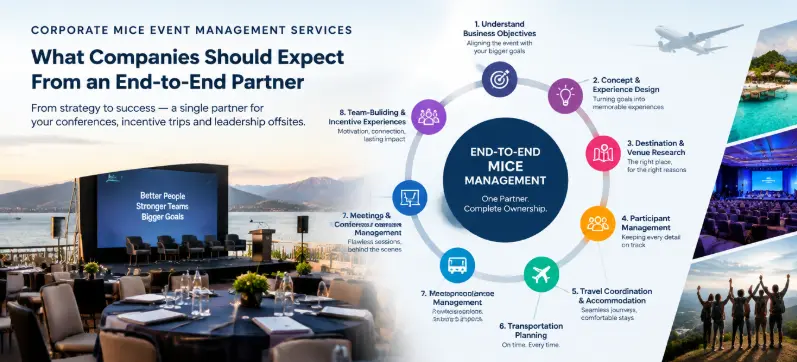
End-to-end MICE management means a single partner takes ownership of the entire event lifecycle rather than handing off pieces to whichever vendor happens to be convenient. That includes strategic planning, logistics, on-ground execution, and reporting afterward.
The alternative — piecing together a venue vendor, a separate travel desk, and an independent production team — often works, but it puts the coordination burden back on the client. Every gap between vendors becomes something an HR or admin manager has to notice and fix themselves, usually under time pressure.
Why Does Understanding Business Objectives Come First?
A conference designed to align leadership around a new strategy looks nothing like an incentive trip designed to reward top sales performers, even if both involve travel and a few days away from the office. Yet many event proposals default to the same generic template regardless of the underlying goal.
A partner worth hiring starts by understanding what the event is actually meant to achieve — motivation, alignment, recognition, or relationship-building — because that objective should shape every decision that follows, from venue choice to the pacing of the agenda.
How Does Event Concept and Experience Design Fit In?
Concept and experience design translate the business objective into something participants will actually feel during the event. This is where a partner decides how sessions flow, how downtime is structured, and what moments are designed to be memorable rather than just functional.
This step matters because a poorly paced agenda undoes even a well-chosen venue. Decision-makers evaluating a partner should ask how they approach this stage, not just what venues they have access to.
Why Is Destination and Venue Research More Complex Than It Looks?
Venue selection isn’t just about capacity and aesthetics. A genuinely useful partner cross-checks accessibility for a distributed participant list, seasonal weather patterns, local infrastructure reliability, and how well a venue supports the specific format of the event — plenary sessions, breakout rooms, or outdoor activities.
Corporate teams rarely have the bandwidth to evaluate multiple destinations against all of these factors simultaneously, which is exactly the research a strong MICE partner should be doing on their behalf.
What Should Participant Management Actually Cover?
Participant management sounds administrative, but it’s often where events quietly go wrong. It includes tracking RSVPs, managing dietary and accessibility requirements, coordinating room allocations, and keeping communication consistent as details change.
For events involving senior leadership or large incentive groups, gaps here are highly visible. A missed dietary requirement or a room mix-up reflects directly on the company hosting the event, not just the vendor managing it.
How Should Travel Coordination and Accommodation Be Handled?
Travel coordination for corporate events differs from routine business travel because it usually involves grouped arrivals, coordinated departures, and tighter timing windows tied to the event schedule itself. Accommodation planning needs to account for group room blocks, upgrade requests for senior attendees, and contingency options if travel gets delayed.
A partner offering corporate travel and event management as part of their service should be able to manage this without requiring the client’s internal team to chase confirmations manually.
Why Does Transportation Planning Deserve Its Own Attention?
Transportation between airports, hotels, and event venues is one of the most common points of failure in multi-day corporate events. Poorly planned transfers create delays that cascade through the entire agenda, frustrating participants before the event has even properly started.
Strong corporate event logistics planning builds in buffer time, backup vehicles, and clear communication protocols so a single delayed flight doesn’t derail an entire day’s schedule.
What Makes Meetings and Conference Management Different From Standard Event Planning?
Conference management involves technical considerations that general event planning doesn’t always account for — AV requirements, session timing across multiple tracks, speaker logistics, and contingency plans if a session runs long or a speaker cancels.
Corporate conference management done well means the audience never notices the coordination happening behind the scenes. That invisibility is usually a sign of strong planning, not luck.
How Do Team-Building and Incentive Experiences Support Business Goals?
Team-building and incentive experiences work best when they’re designed around what will genuinely resonate with the specific group, rather than generic activities recycled across every client. A leadership team and a sales incentive group have very different expectations for what a rewarding, engaging experience looks like.
This is where corporate incentive travel management becomes distinct from ordinary trip planning — the experience itself needs to feel earned and memorable, not just logistically sound.
Why Do Entertainment, Food, and Hospitality Choices Matter More Than They Seem?
Entertainment and hospitality choices shape how participants remember an event long after the agenda details fade. Food quality, service pacing, and entertainment relevance to the audience all contribute to whether an event feels premium or merely adequate.
These elements are often underestimated in planning conversations, yet they’re frequently what participants mention first when asked about their experience afterward.
What Role Does Branding and Production Play in Corporate Events?
Branding and production cover everything from stage design and signage to audiovisual execution and any recorded content from the event. For leadership conferences or incentive trips tied to a company milestone, this is where the event visually reinforces the message it’s meant to deliver.
A partner without in-house production capability often has to bring in a separate vendor at this stage, adding another coordination layer the client has to manage.
Why Is Vendor Management a Core Part of MICE Services, Not a Side Task?
A single corporate event can involve venues, caterers, transport providers, AV teams, entertainment acts, and photography or production crews. Managing all of these vendors consistently, and holding each one accountable to the same standard, is a significant operational task on its own.
This is precisely the value proposition behind corporate MICE event management — a single point of accountability instead of a client having to manage a dozen separate vendor relationships directly.
What Does On-Ground Coordination Actually Look Like During the Event?
On-ground coordination is where all the earlier planning gets tested in real time. It means having dedicated staff present throughout the event who can solve problems as they arise, adjust schedules on the fly, and manage the countless small issues that never show up in a planning document.
Corporate decision-makers should ask specifically how a partner staffs on-ground coordination, since this is often the difference between an event that runs smoothly and one that visibly struggles.
Why Does Risk and Contingency Planning Matter for Corporate Events?
Weather disruptions, travel delays, vendor no-shows, and last-minute participant changes are common enough that any experienced MICE partner should have contingency plans built in before the event starts, not improvised after something goes wrong.
Asking a potential partner how they’ve handled disruptions in the past, and what backup plans they typically build into their process, is a reasonable and useful question during evaluation.
What Should Post-Event Reporting Include?
Post-event reporting closes the loop on the entire process. It typically covers attendance and participation data, budget reconciliation, feedback summaries, and an honest assessment of what worked well and what could improve for future events.
This step is often skipped by less experienced vendors, yet it’s genuinely useful for HR and leadership teams trying to justify the event’s value or refine their approach for the next one.
How Should Corporate Teams Evaluate a MICE Event Management Partner?
A few practical questions help separate a genuinely end-to-end partner from one that only handles part of the process:
- Do they manage the full lifecycle, or hand off key components to third parties you’d need to coordinate separately?
- How do they approach risk and contingency planning before an event, rather than reacting during one?
- Can they demonstrate a clear process for vendor management and on-ground coordination?
- Do they provide meaningful post-event reporting, or does engagement end once the event itself is over?
Companies evaluating agencies for corporate conferences, incentive trips, or leadership offsites are better served by asking these process-oriented questions than by comparing venue portfolios alone.
Bringing It Together
Corporate MICE event management services work best when a single partner owns the entire journey — from understanding business objectives through to the report that follows the event. Piecing together separate vendors for each component might seem manageable on paper, but it usually shifts the coordination burden right back onto the internal team that outsourced the event to begin with.
If your team is evaluating partners for an upcoming conference, incentive trip, or corporate offsite, Bigbee Experience works with corporate teams through the full MICE lifecycle described here. You can explore our MICE event management services for more on how we approach destination planning, on-ground execution, and reporting, or reach out directly to discuss what your event actually needs.
Frequently Asked Questions
What is included in corporate MICE event management services? Corporate MICE event management typically includes planning and objective-setting, venue and destination research, participant and travel coordination, on-ground execution, vendor management, and post-event reporting.
How is MICE event management different from regular event planning? MICE event management specifically covers meetings, incentives, conferences, and exhibitions, which usually involve travel, multi-day logistics, and larger participant groups than a typical single-venue corporate event.
What should a company look for in a corporate incentive travel management partner? Look for a partner who can manage destination research, group travel logistics, and experience design together, rather than treating travel booking and event experience as separate, disconnected tasks.
How far in advance should a company start planning a corporate conference or incentive trip? Lead time depends on group size and destination complexity, but starting the conversation with a MICE partner early gives more room to secure preferred venues and build in proper contingency planning.
Does a MICE partner handle post-event reporting? An end-to-end partner should provide post-event reporting covering participation, budget reconciliation, and feedback, which helps internal teams evaluate the event’s impact and plan future ones more effectively.